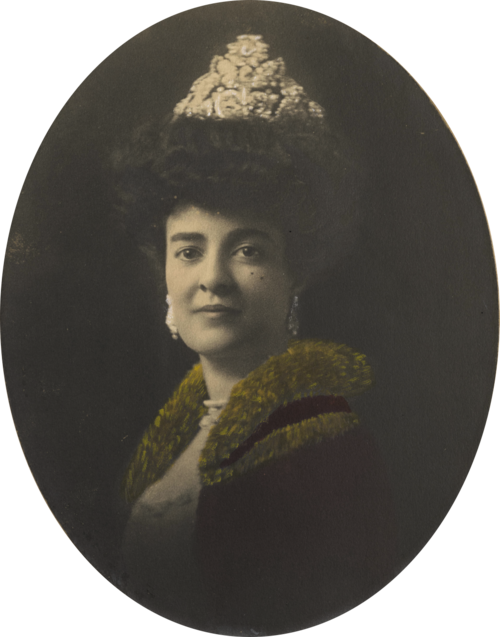
Honoring the life and legacy of Abigail Campbell Kawānanakoa, Class of 1900, whose journey from the College of Notre Dame to a prominent role in Hawaiian history reflects an extraordinary chapter in NDNU's 175-year educational legacy.
The history of Notre Dame de Namur University (NDNU) spans generations of students whose lives and careers have taken them in remarkable directions. Among its early graduates was Princess Abigail Wahiʻikaʻahuʻula Campbell Kawānanakoa (1882–1945), a member of Hawaiian royalty by marriage, political leader, and advocate for Native Hawaiian interests.
Long before she became known as Princess Abigail, she was a young woman pursuing her education at the College of Notre Dame, the institution that would eventually become Notre Dame de Namur University.
Graduating in 1900, Abigail's educational journey connects NDNU's early history as a women's college with an influential figure in Hawaiʻi's political and cultural history.
Early Life: Growing Up in the Kingdom of Hawaiʻi
Abigail Campbell was born on January 1, 1882, in Honolulu, during the final decade of the Kingdom of Hawaiʻi.
Her father, James Campbell, was a prominent businessman and landowner who became one of the wealthiest individuals in the Hawaiian Islands. Her mother, Abigail Kuaihelani Maipinepine Bright, came from a family with Native Hawaiian ancestry and connections to Hawaiian society.
Growing up during a period of significant political and cultural change, Abigail witnessed an era that would reshape Hawaiʻi's future. The overthrow of the Hawaiian monarchy in 1893 and subsequent annexation by the United States in 1898 occurred during her youth.
These events formed the historical backdrop to her later involvement in Hawaiian political affairs.
A Notre Dame Education: Class of 1900
Before entering public life, Abigail traveled to California to continue her education at the College of Notre Dame in San Jose.
Founded in 1851 by the Sisters of Notre Dame de Namur, the institution was chartered in 1868 as the first college in California authorized to grant bachelor's degrees to women.
At a time when higher education opportunities for women were still limited, the College of Notre Dame provided an educational environment rooted in academic learning and Catholic tradition.
Abigail graduated from the College of Notre Dame in 1900, more than two decades before the institution relocated to Belmont in 1923. The college later adopted the name Notre Dame de Namur University in 2001.
Accounts of her life also describe her conversion from Anglicanism to Roman Catholicism during her time at Notre Dame, marking an important personal and religious transition.
Although detailed records of her individual academic experiences are limited, her graduation represents a meaningful connection between NDNU's educational history and the broader history of Hawaiʻi.
More than a century later, Abigail remains an example of the diverse backgrounds and paths represented among the institution's alumni.
Becoming Princess Abigail Kawānanakoa
On January 6, 1902, two years after graduating, Abigail married Prince David Laʻamea Kahalepouli Kawānanakoa Piʻikoi in San Francisco.
Prince David was a member of the Hawaiian royal family and had been recognized as an heir to the Hawaiian throne. Through their marriage, Abigail received the courtesy title of princess and became closely associated with the House of Kawānanakoa.
The couple had three children: Abigail Kapiʻolani, David Kalākaua, and Lydia Liliʻuokalani Kawānanakoa.
Their family maintained important connections to Hawaiʻi's royal heritage during a period when the islands were transitioning from an independent kingdom to a United States territory.
Tragedy struck in 1908 when Prince David died of pneumonia, leaving Abigail a widow with three young children.
In the years that followed, she would establish a public identity extending beyond her royal connections.
A Woman of Political Influence
Following the death of her brother-in-law, Prince Jonah Kūhiō Kalanianaʻole, in 1922, Princess Abigail became an increasingly prominent figure in Native Hawaiian political and community affairs.
She participated actively in territorial politics and became an advocate for Native Hawaiian interests during a period of significant political transformation.
In 1924, she was selected as the Republican National Committeewoman for Hawaiʻi, a position she held for 12 years, until 1936.
Her role placed her within national political discussions at a time when women's participation in political leadership was expanding following the ratification of the 19th Amendment in 1920.
As a political leader with ties to Hawaiian royalty, Abigail occupied a distinctive position between the traditions of the former Hawaiian Kingdom and the political institutions of the territorial United States.
Her work and public visibility made her an important figure in Hawaiʻi's early 20th-century political history.
A Legacy Connected to Hawaiian History
Princess Abigail's influence extended beyond her formal political responsibilities.
Through her family connections and public leadership, she remained closely associated with Hawaiʻi's royal heritage and the ongoing importance of Native Hawaiian identity during the territorial era.
Her life reflected the complex relationship between Hawaiʻi's monarchy, its Indigenous communities, and the political changes that followed annexation.
Princess Abigail died on April 12, 1945, in Honolulu, at the age of 63. She was buried at Mauna ʻAla, the Royal Mausoleum of Hawaiʻi, a resting place for members of the Hawaiian royal families.
Her story continues to be documented by historians studying Hawaiian political leadership, royal history, and the role of women in the islands' territorial period.
An Extraordinary Chapter in NDNU's Alumni History
As Notre Dame de Namur University reflects on its 175-year history, Abigail Campbell Kawānanakoa's story offers a connection to the institution's earliest generations of graduates.
Her time at the College of Notre Dame represents a period when the Sisters of Notre Dame de Namur were expanding educational opportunities for women in California.
From her graduation in 1900 to her later prominence in Hawaiian political life, Abigail's journey illustrates the many directions an educational experience can precede.
Her accomplishments were shaped by her family background, historical circumstances, and personal involvement in public life. Her place in NDNU's history is significant because it connects the university to a notable woman whose life intersected with major developments in Hawaiian history.
More than 125 years after her graduation, Princess Abigail Campbell Kawānanakoa remains a notable figure in Notre Dame de Namur University's alumni history and a reminder of the institution's longstanding connections to communities beyond California.
About Notre Dame de Namur University
Founded in 1851 by the Sisters of Notre Dame de Namur, Notre Dame de Namur University is one of California's oldest institutions of higher education. Originally established in San Jose, the university relocated to Belmont in 1923.
Today, NDNU continues its educational mission through undergraduate degree-completion programs, graduate degrees, and professional credentials in business, education, and psychology.
Learn more about NDNU's history and academic programs at www.ndnu.edu.