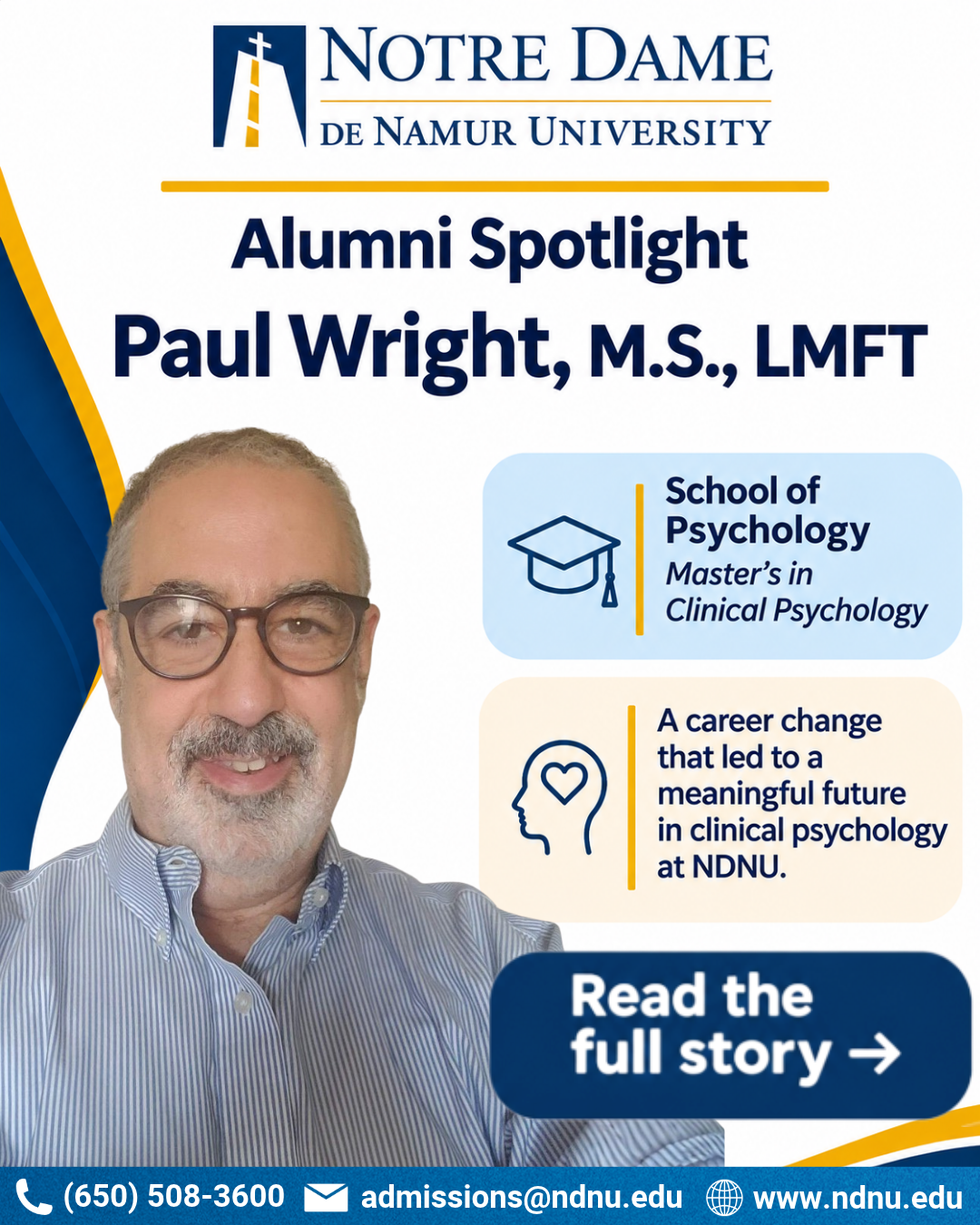
Discover how NDNU's practitioner-focused faculty, supportive learning environment, and hands-on education helped Paul Wright prepare for a rewarding career in mental health.
Sometimes, pursuing a new career means taking a chance on something entirely different. For Paul Wright, M.S., LMFT, that decision led him to Notre Dame de Namur University's (NDNU) School of Psychology, where he found an educational experience that would shape his approach to working as a mental health professional.
From his first introduction to NDNU through an information session to the lessons he continues to apply in his professional career, Paul's journey highlights the lasting impact of supportive faculty, practical education, and meaningful connections.
Finding a New Direction at NDNU
When Paul began exploring a career change, he researched several universities throughout the San Francisco Bay Area. He was looking for a program that would help him transition into the mental health field while providing the education and preparation needed for his new professional path.
NDNU stood out during the admissions process.
"I needed a change of career and looked into several Bay area schools. I was impressed by their Information session/Open House, the speakers and what was said there."
That initial experience helped Paul recognize NDNU as a place where he could pursue his next chapter.
Learning From Faculty Who Practice What They Teach
One of the most valuable aspects of Paul's experience at NDNU was learning from faculty members who brought their professional experience directly into the classroom.
Rather than focusing solely on textbooks and theory, his professors shared insights from their work as practicing therapists, helping students connect academic concepts to situations they might encounter in their own careers.
"Having professors that were working therapists and sharing their experience and knowledge in the field. Also, having professors and staff that were approachable and encouraging."
For Paul, this combination of professional expertise and a supportive learning environment made a lasting impression.
It also reflects a central part of NDNU's approach to clinical psychology education: connecting foundational knowledge with real-world perspectives from professionals actively working in the field.
Lessons That Continue to Make an Impact
The value of Paul's NDNU education did not end when he completed his degree.
Throughout his professional career, he has continued to draw upon lessons, discussions, and insights from his time in the School of Psychology.
"There are things that were said and taught that I've always remembered, used and quoted in my professional career."
Several courses were particularly meaningful to his development.
Paul specifically remembers his Couples Counseling course, noting that he continues to reference lessons from the class in his work today.
He also identified Cross-Cultural Issues, Psychopathology, Family Systems Theory, Diagnosis and Treatment, and Ethics and Law as courses that contributed significantly to his educational experience.
Together, these subjects provided opportunities to explore the complexities of human behavior, relationships, clinical assessment, and ethical decision-making.
For Paul, the lasting value of these courses demonstrates how graduate education can influence not only what professionals know, but also how they approach their work.
Advice for Future Mental Health Professionals
Having navigated a career change and pursued his education in clinical psychology, Paul encourages prospective students to explore the mental health profession from multiple perspectives before choosing their path.
His advice is to speak with professionals working in different roles and environments.
"Talk to as many people in the field as possible-MFT's, MSW's, Associates, Supervisors in all levels of the field including private practices, clinics, schools, hospitals, community mental health centers, and substance abuse treatment facilities."
His recommendation highlights the variety of professional settings available within the mental health field.
By connecting with a variety of mental health professionals, prospective students can gain a better understanding of different career opportunities, workplace environments, and professional responsibilities.
These conversations can also help students make more informed decisions about their education and long-term goals.
Preparing Future Mental Health Professionals at NDNU
Paul's experience reflects the importance of an education that combines academic knowledge, practical perspectives, and faculty support.
At Notre Dame de Namur University's School of Psychology, students learn from faculty who bring professional experience into the classroom while exploring the theories, skills, and ethical foundations essential to clinical practice.
NDNU offers graduate pathways designed for students pursuing careers in mental health, including:
- Master of Science in Clinical Psychology (MSCP): A non-licensure path where you can explore human behavior, psychological theory, and clinical concepts through a comprehensive graduate education.
- Marriage and Family Therapy (MFT): Prepare for professional licensure focused on supporting individuals, couples, and families.
- Licensed Professional Clinical Counseling (LPCC): Pursue coursework designed to support preparation for licensure in clinical counseling careers.
With flexible scheduling, clinically experienced faculty, and opportunities to connect classroom learning with professional practice, NDNU supports students at different stages of their educational and career journeys.
Whether you're transitioning into the mental health field, advancing your education, or exploring a new professional direction, NDNU provides opportunities to build the knowledge and skills needed to move forward.
Your Next Chapter Starts Here
For Paul Wright, choosing NDNU was more than a step toward a new career. It was an opportunity to learn from experienced professionals, develop meaningful connections, and gain knowledge that continues to influence his work as a licensed marriage and family therapist.
His story is a reminder that a career change can lead to lasting professional growth—and that the lessons learned along the way can continue making a difference for years to come.
Ready to explore your future in clinical psychology?
Learn more about NDNU's School of Psychology and discover how our graduate programs can help you take the next step toward your professional goals.