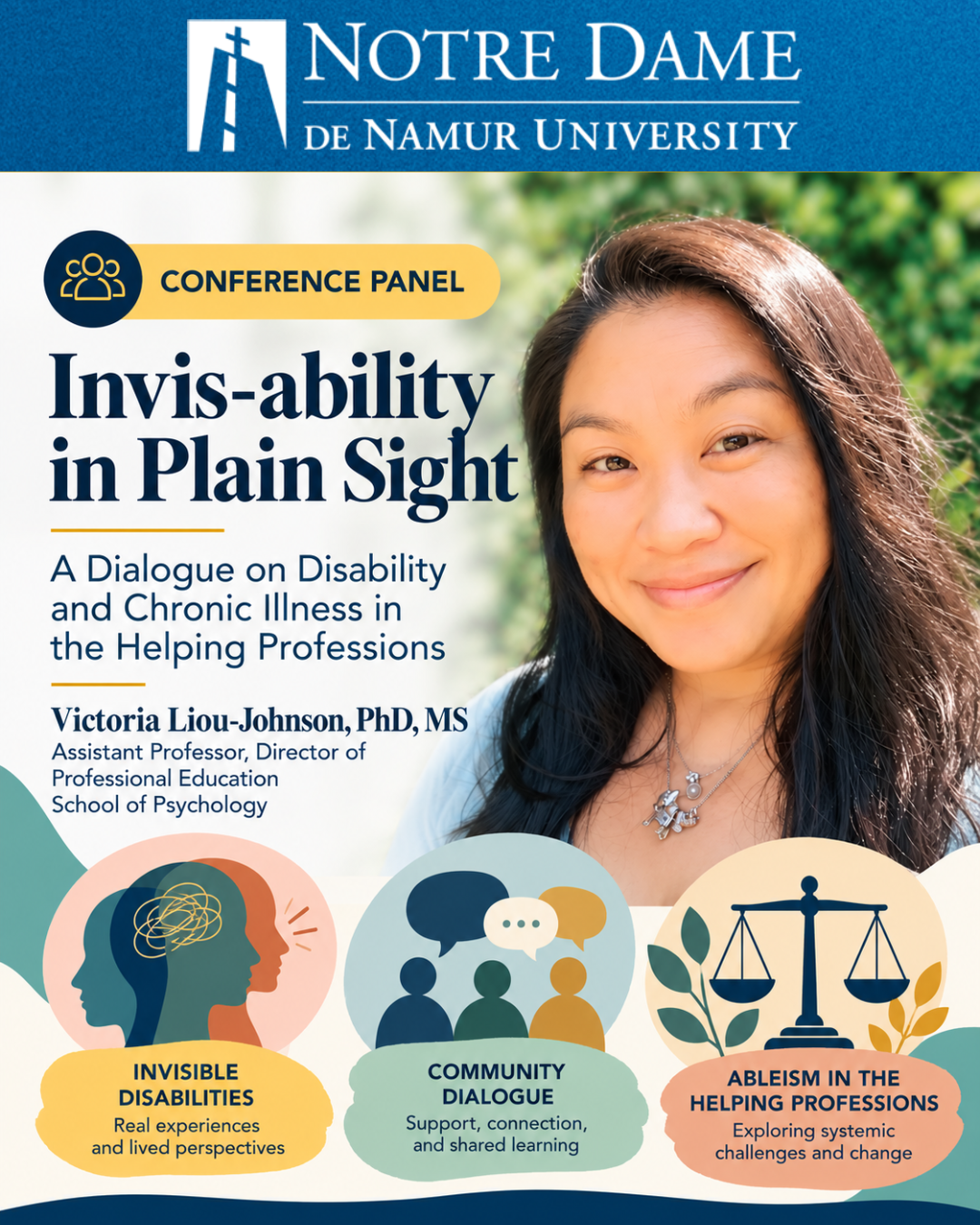
NDNU School of Psychology Assistant Professor and Director of Professional Education Victoria Liou-Johnson, PhD, MS, joined fellow psychologists at the APA Division 35 Section 53rd Convention of Asian Pacific Feminist Psychologists for a panel examining disability, chronic illness, ableism, and the lived experiences of professionals working in helping fields.
Notre Dame de Namur University’s School of Psychology is proud to highlight the work of Victoria Liou-Johnson, PhD, MS, Assistant Professor and Director of Professional Education, whose scholarship and professional engagement address disability justice, social justice, and the experiences of people with disabilities and chronic illnesses.
In June 2026, Dr. Liou-Johnson participated in the APA Division 35 Section 5 3rd Convention of Asian Pacific Feminist Psychologists, held June 4–6 in San Diego, California. She joined Richelle Concepcion, PsyD, MPH, and Amy M. Kobus, PhD, for the conference panel “Invis-ability in Plain Sight: A Dialogue on Disability and Chronic Illness in the Helping Professions.”
The conversation provided an opportunity to examine an important issue that can remain overlooked: the experiences of psychologists and other helping professionals who are simultaneously navigating their own chronic illnesses or disabilities.
Creating Space for Lived Experiences
According to Dr. Liou-Johnson, the panel was designed to open a supportive community dialogue and center lived-experience narratives about the realities of working in a helping profession while managing serious chronic or acute disabling medical conditions.
The panelists brought lived experiences involving a range of serious health concerns, including encounters with ableism in employment, academic institutions, and medical settings. The conversation also created an opportunity to connect with mental health providers, and mental health providers-in-training and foster greater understanding and community support.
At the center of the discussion was a tension that may be particularly significant within helping professions: professionals can be expected to provide care, assistance, and support to others while facing barriers to receiving understanding and support for their own disabilities or health needs.
For individuals whose disabilities are not immediately apparent, those challenges can take additional forms.
Dr. Liou-Johnson emphasized that people with disabilities are an important and sometimes overlooked part of society, particularly those with “invisible” disabilities. Individuals with invisible disabilities may encounter disbelief and feel compelled to disclose sensitive medical information in an effort to establish that their disability is legitimate. They may also face pressure to work beyond their capacity to demonstrate that they are capable of performing their work.
Understanding Ableism and Structural Ableism
The presentation placed these lived experiences within a broader discussion of ableism and structural ableism.
As outlined in the panel's presentation materials, ableism refers to discrimination against individuals who have disabilities or are not able-bodied. The presentation further described how ableism can be supported by the erroneous belief that able-bodied people are superior, creating bias against people who are not able-bodied.
The panel also explored structural ableism, shifting the conversation beyond individual attitudes or interactions to the broader environments in which people live, learn, and work.
The presentation described structural ableism as encompassing historical and contemporary policies, institutions, societal norms, and practices that can disadvantage people who are disabled, neurodivergent, chronically ill, or living with mental illness while privileging people positioned as able-bodied and able-minded.
That distinction is significant because barriers experienced by people with disabilities may not result solely from one person's attitudes or actions. They can also be embedded within expectations, organizational practices, professional cultures, and institutions.
The “Capability Imperative” in Helping Professions
Another central concept explored during the presentation was the “capability imperative.”
The presentation describes the capability imperative as the expectation that healthcare providers conform to a particular prototype of able-bodiedness. The concept addresses outdated stereotypes that can equate disability with lower intelligence or decreased work ethic while treating able-bodiedness as an indicator of intellectual ability and professional success.
For providers living with disabilities or chronic illnesses, these expectations can create a difficult contradiction. A person may be fully qualified to perform their professional role while simultaneously navigating an environment in which requesting accommodations, discussing health limitations, or acknowledging disability can challenge assumptions about what a capable provider is supposed to look like.
By addressing these issues through lived experiences as well as psychological and scholarly perspectives, the panel invited attendees to consider how the helping professions themselves can become more aware of the expectations they place on the people working within them.
Building Community Through Conversation
The panel was presented as part of the APA Division 35 Section 5 3rd Convention of Asian Pacific Feminist Psychologists. In keeping with the spirit of the conference, Dr. Liou-Johnson and her fellow panelists sought not only to discuss disability and chronic illness but also to create an opportunity for connection among psychologists and psychologists-in-training.
That community-centered approach was an important element of the presentation. Rather than considering disability only as an abstract academic topic, the panel elevated the voices and experiences of mental health providers, and mental health providers in training, who have directly navigated these challenges.
The discussion encouraged participants to consider what greater equity, access, understanding, and belonging could look like within psychology and other helping professions—and how professional communities can better recognize people whose disabilities may not always be visible.
Bringing Contemporary Conversations into NDNU’s School of Psychology
Dr. Liou-Johnson’s participation in the conference also connects directly with her work at Notre Dame de Namur University’s School of Psychology.
She identified connections between the panel's subject matter and NDNU’s Hallmarks, as well as topics addressed across several courses she teaches: Lifespan Development, Neurophysiology & Pharmacology, and Cross Cultural Issues.
These connections provide an example of how the professional and scholarly work of NDNU faculty can inform students' classroom experiences. Conversations about disability and chronic illness intersect with questions of human development, culture, identity, health, mental health, social systems, equity, and the ways professionals understand and respond to the experiences of others.
The conference presentation also builds upon Dr. Liou-Johnson’s broader work in social justice and disability justice. Her recent scholarly work includes the book chapter “Beyond the Visible: Addressing Ableism in Medical Practice,” published in Systemic Ableism: Critical Perspectives on Disability, Equity, and Access. She previously identified that work as connected to the social and disability justice issues she explores in her Cross Cultural Issues course.
Together, these professional activities reflect the School of Psychology’s emphasis on connecting psychological study with the complex social, cultural, and real-world contexts that shape people's experiences.
At NDNU’s School of Psychology, students have opportunities to learn from faculty whose scholarship and professional engagement extend beyond the classroom. Faculty members such as Dr. Liou-Johnson bring current conversations from academic research and clinical practice and related fields into their teaching, encouraging students to examine human behavior and experience with greater awareness of culture, systems, equity, and individual lived experience.
Through scholarship, professional dialogue, and teaching, Dr. Liou-Johnson’s work offers an example of how psychology can help illuminate experiences that may otherwise remain—in the words of the conference presentation—“in plain sight.”
Learn more about NDNU’s School of Psychology:
https://www.ndnu.edu/psychology/
Learn more about the APA Division 35 Section 5 convention:
2026 Convention of Asian Pacific Feminist Psychologists